Open an American Mahjong set for the first time and 152 tiles can look like a great deal to learn. In fact, they fall into just seven groups, and once you know them, reading a rack quickly becomes second nature. Here is every tile, what it looks like, and how it’s used.
The set at a glance
| Group | Tiles | Count |
|---|---|---|
| Bams | 1–9, four of each | 36 |
| Craks | 1–9, four of each | 36 |
| Dots | 1–9, four of each | 36 |
| Winds | North, East, West, South, four of each | 16 |
| Dragons | Red, Green, White, four of each | 12 |
| Flowers | All interchangeable in play | 8 |
| Jokers | Used only in groups of three or more | 8 |
| Total | 152 |
The three suits
The suits make up most of the set: 108 tiles in all. Each suit runs from 1 to 9, with four of every number.
Bams
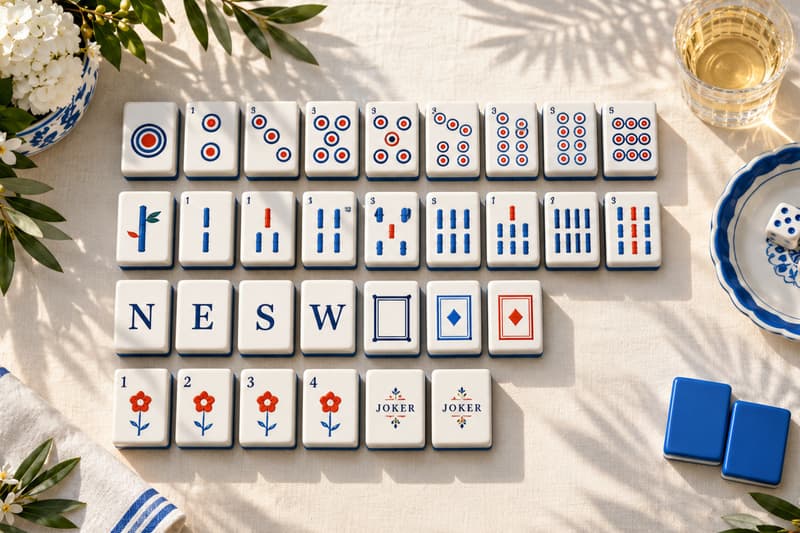
Bams, short for bamboo, show sticks of bamboo matching the number on the tile. The exception is the 1 Bam, which is traditionally drawn as a bird. Because it doesn’t look like a 1, it’s worth learning early.
Craks
Craks, short for characters, show the number written in Chinese characters. American sets often add a small numeral in the corner, which makes them much easier to read while you’re learning.
Dots
Dots, sometimes called circles, are the simplest to read: count the circles and you have the number.
The same numbers appear in all three suits, and many hands on the card call for numbers in two or three suits at once. Remember that the colors on the card show different suits rather than particular ones. A hand printed in one color uses a single suit, while two or three colors mean two or three different suits.
Winds
There are 16 Winds: North, East, West, and South, four of each. They have no suit and no number. The Winds also name the seats at the table. East is the dealer, and the other seats follow to East’s right: South, West, then North. Winds often appear together on the card, as in a “NEWS” hand.
Dragons
There are 12 Dragons, four each of Red, Green, and White. In American Mahjong, each Dragon belongs to a suit:
- Red Dragon: Craks
- Green Dragon: Bams
- White Dragon, known as Soap: Dots
This matters when you read the card. When a hand shows a Dragon in the same color as a group of numbers, it means the Dragon that belongs to that same suit.
Soap has a second job: it serves as a zero in year hands. In a hand built around 2026, for example, Soap stands in for the 0.
Flowers
There are eight Flowers. Their pictures often differ from tile to tile, but in American play all eight are interchangeable, so any Flower counts the same as any other. You’ll find Flowers in many hands on the card.
Jokers
The eight Jokers are what make a set truly American. They follow a few firm rules:
- A Joker can stand in for any tile in a group of three or more: a pung, kong, quint, or sextet.
- A Joker can never be used as a single tile or in a pair.
- Jokers may never be passed in the Charleston.
- Joker exchange: if an exposed group on any player’s rack contains a Joker and you hold the real tile it represents, you may swap your tile for the Joker on your turn.
- You can’t claim a discard just to exchange it for a Joker, and a discarded Joker can’t be called by anyone.
Because there are only four of each suit, Wind, and Dragon tile, a group of five or six of any of them can only be made with the help of Jokers.
The names for groups
You’ll hear these words at every table:
- Single: one tile
- Pair: two identical tiles
- Pung: three
- Kong: four
- Quint: five
- Sextet: six
Learning the tiles quickly
- Sort as you go. Group your rack by suit, with Winds, Dragons, Flowers, and Jokers together at one end.
- Learn the tricky tiles first: the 1 Bam, Soap, and your own set’s Jokers and Flowers, whose designs vary from set to set.
- Say every discard aloud. Naming each tile as you discard it, such as “five dot,” helps fix the tiles in your memory and keeps the game friendly.
- Play a few hands open. With racks turned face up, everyone can point out tiles and talk through their choices together.
Keep every tile accounted for
A quick count of your Jokers and Flowers after each game catches a missing tile before it’s lost for good. Our care guide has more on keeping tiles clean and safe between games. If you’re still shopping, our guide to choosing a Mahjong set explains what to look for, and if you’ve wondered why some sets have fewer tiles, see American Mahjong vs. Chinese Mahjong.
Ready for your first game
Once the tiles feel familiar, the rest of the game follows naturally. Our step-by-step guide to American Mahjong takes you from building the wall to declaring Mahjong, one clear step at a time.