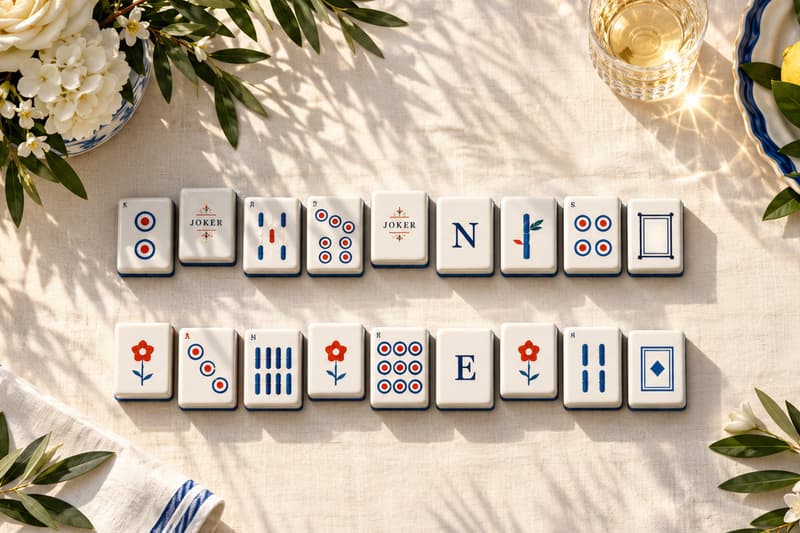
Sit down at an American Mahjong table after learning another style, and much of it will feel familiar: four players, the click of tiles, a wall built in the center, and the quiet satisfaction of completing a pung. Then someone passes three tiles to the right, someone else reaches for a joker, and everyone checks a small printed card. American Mahjong grew from the Chinese game, but in the United States it became a game of its own.
One family, many styles
Mahjong began in China and reached the United States in the early twentieth century, where American players gradually developed their own rules. The National Mah Jongg League was founded in 1937, and today it publishes the card of winning hands that American players follow each year.
“Chinese Mahjong,” meanwhile, isn’t a single game. There are many regional styles, Cantonese (or Hong Kong) style among the best known, and their rules and scoring can differ a good deal. The comparisons below describe broad patterns rather than the rules of any one style.
At a glance
| Feature | American Mahjong | Chinese styles |
|---|---|---|
| Tiles | 152, including 8 flowers and 8 jokers | Commonly 136, or 144 with flowers and seasons |
| Jokers | Eight, used only in groups of three or more | None |
| The Charleston | Played before every hand | Not played |
| Winning hands | Must match a hand on the current year’s card | In most styles, four sets plus a pair |
| Sequences | Hands can include runs of numbers, but discards are called only to complete groups of matching tiles, or to win | Sequences (chows) are allowed and can be claimed |
| Scoring | Each hand’s value is printed on the card | Varies widely by regional style |
The tiles
Both games share the same core: three suits of Bams, Craks, and Dots, numbered 1 to 9 with four of each (108 tiles), plus 16 Winds and 12 Dragons. That’s 136 tiles, the count many Chinese styles play with. Add eight flowers and seasons and you have 144. American sets keep eight flowers and add eight jokers, for 152 in all.
The flowers play a different role, though. In American Mahjong, flowers are part of your hand: all eight are interchangeable, and they appear in many hands on the card. In Chinese styles that use them, flowers and seasons usually work as bonus tiles, set aside when drawn and replaced with another tile.
The Dragons take on an extra job in American play, too. Each one belongs with a suit: Red with Craks, Green with Bams, and White, known as Soap, with Dots. Soap also stands in as a zero in year hands such as 2026.
One practical consequence: a set made for Chinese play has no jokers, so it can’t be used for an American game as it is. Our guide to choosing a Mahjong set explains what to check before you buy.
Jokers
Jokers are the most visible difference between the two games. The rules are simple:
- A joker can stand in for any tile in a group of three or more: a pung, kong, quint, or sextet.
- A joker can never be used as a single tile or in a pair.
- If an exposed group on any player’s rack contains a joker and you hold the real tile it represents, you may swap your tile for the joker on your turn.
- A discarded joker can’t be called by anyone, and you can’t claim a discard just to exchange it for a joker.
Chinese styles have no jokers at all.
The Charleston
Before each hand of American Mahjong, players pass tiles in a set sequence:
- The first Charleston (always played): three tiles to the right, three across, then three to the left.
- The second Charleston (optional): if no one stops it, three to the left, three across, then three to the right.
- The courtesy pass (optional): you and the player across from you may exchange up to three tiles, by agreement.
Jokers may never be passed. It’s a chance to shape your hand before the first discard. Chinese styles have nothing like it: once the deal is done, play begins.
A card of hands versus a pattern
In American Mahjong, you win by building 14 tiles that exactly match one of the hands on the current card. Each spring, the League publishes a new card, which players order directly from the League. Its hands are grouped into families such as year hands, consecutive runs, and winds and dragons, and some must be played concealed. Because the hands change every year, even longtime players get to start fresh.
Most Chinese styles have no card. A standard winning hand is four sets plus a pair, and the sets can be pungs, kongs, or chows. Players shape their hands more freely, then aim for the combinations their style rewards.
Calling discards
In American Mahjong, you may call a discard to complete a group of three or more matching tiles, which you then expose on your rack. You can’t call a discard for a single tile or a pair unless it completes your Mahjong, and for concealed hands, only the final tile may be called.
Chinese styles allow pungs, kongs, and chows to be claimed from discards, with the finer details depending on the style.
Scoring
American scoring is refreshingly straightforward. Each hand’s value is printed beside it on the card. The player whose discard completed the hand pays the winner double and everyone else pays the value shown; if the winner drew the winning tile, all three players pay double. Many tables add house rules, such as a bonus for a hand made without jokers.
Chinese scoring varies widely by region and even by table, so agree on the rules before the first hand.
Which should you learn?
If your friends play from the League card, learn American Mahjong. If you already play another style, much of what you know carries over: the tiles, the wall, pungs and kongs, and the habit of watching discards. Add the Charleston, the jokers, and the card, and you’re most of the way there.
Our step-by-step guide to American Mahjong walks through a full game, and What You Need to Play American Mahjong covers the essentials. For a closer look at every tile, see our guide to Mahjong tiles.
Both games share the best part, of course: four people around a table, an unhurried afternoon, and a pitcher of lemonade within reach.